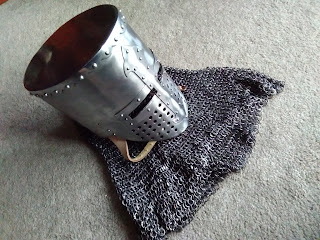
Picked up a primitive great helm otherwise known as an enclosed helmet to add to my medieval armory collection. Produced by GDFB ( Get Dressed For Battle) the familiar flat top crusader style helmet is made of 14 gauge steel, lined with a leather suspension system, weighs in at about eight pounds and is WMA authorized for combat sport. The enclosed helmet first appeared around the end of the 12th century after Norman nasal helms began to evolve with added face protection and a square profile. In retrospect the cylinder flat top profile seems counter intuitive and a step back from the conical deflective properties of spangenhelms but became the dominant helmet design of the high middle ages with sugar loaf and great helm versions being used into the 14th century. Typically worn with a padded cap and chainmail coif the enclosed helmet was probably developed in response to the use of heavy lances by armored knights and massed archers upon the medieval battlefield...
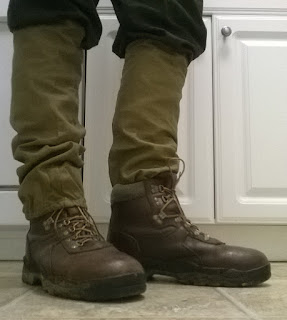
I realized this past winter preparing for snow shoeing that gaiters might just have an anti tick application. Typically they quest for hosts in low shrub and tall grasses which means they attach on your lower legs. Gaiters usually cover the lower legs from knees to footwear with some styles having heel straps that secure them in place. Gaiters could provide protection in two ways; first by covering up the gap between footware and pant hem that allow ticks to get under the pant leg and gain access to skin. The first line of defense is keeping them on the outside of your clothing. Secondly any gaiter made from a light color fabric would facilitate one being able to see the critters before they have an opportunity to climb upward looking for a gap in your clothes. With that in mind I picked up a pair of former East European military gaiters on EBay. Made of khaki cotton with snug elasticized hems they are both light weight and breathable. Long enough to cover ankles to knees I ca...
Recently I have been doing some research into the Chinese practice of achieving "Chi", the balancing of the body`s "life force" in terms of well being.The premise being that to have good health one must balance positive/negative energies (ions)to achieve harmony. From what I have ascertained thus far the act of living creates positive ions in the body that need to be countered by negative ions. They attract each other and become as one. Nature, it seems, supplies negative ions through good food, clean air and pure water. The problem is that we now live in an increasingly polluted enviroment where pure food, water and air is at a premium.It is harder for the body to get the negative ions it needs to balance the positive ones that are the byproducts of living.It all reminds me of the whole free radical/antioxidant debate. Are they, in fact, one and the same?One an ancient Far Eastern belief and the other a 20th century scientific standard but both essentially the same...
Comments